Triumph GT6 MKIII Dash

Triumph GT6 MKIII Dash

Sunday, 22 February 2015

The Gray Ratsnake Project - Proposal

For my Hist*4170 capstone project, my aim is to create an all encompassing website on the Gray Ratsnake and its history (both past and more present) within the boundaries of Murphys Point Provincial Park. In turn, the project will take the form of an online exhibit or even museum if you wish, as the site itself is divided into separate portions. The site opens to a home page where you can then decide where you wish to begin. Most who are new to the site and the species will commence with the identification portion, then look into the history of the park that has been linked to the Gray Ratsnake, this is followed by a section on the park’s current standings with the Gray Ratsnake and then the last core exhibit of the site will be based on research that took place over the past year or so. The site will also include easy to navigate subcategories for each core section as to provide both ease of navigation and to split the information up. Additional subheadings will be present that offer information on what the site is, where people can find resources on the Gray Ratsnake and so forth. The website will be full of visuals, and be written to appeal to an audience of teenagers and older, that being said I do believe anyone could use this site if they so pleased, as it will serve as a great source for a wide range of Gray Ratsnake information.

It is understandable that since the project has such a heavy focus on the Gray Ratsnake there may be a concern on how this relates to the digital humanities and the teachings of the course. It is true, that some portions, such as the identification section of the site, will not feature a heavy dosage of “humanities” related information; however this section is essential as it provides critical information on the species that is required to better understand the snake and to better understand human interactions with the species. Where it ties in with the humanities is in the potions of the site that deal with human interactions and the park’s history. These potions of the site look at how people have shaped not only the habitat of the Gray Ratsnake but also its population numbers. The snake after all, is a species at risk and by no means is it at risk because of climate change or over predation. We have directly impacted their population through the destruction of critical habitat, interference in their movement, and a general hatred towards snakes. This just goes to show that talking about natural history proves almost impossible without involving human/cultural history.

The website will be made using the website creation site known as Weebly. The source comes at no cost and allows for a wide range of website features to be completed. I will be working heavily with programs such as Photoshop to create display images very similar to what you would come across in a museum. Images will all be obtained either from my personal collection or the Murphys Point Provincial Park photograph archive. Some sections will feature aerial images as well as maps to help demonstrate a scope of information (from snake movement to the impact of humans on a region and so forth). Data from a range of research project that have taken place within the park will also be used, to help demonstrate a number of things, but mostly to show snake movement patterns as well as flocculation in the snake’s population within the park. It is at this point I should also mention two important things. When using this data I will be not only be using it to prove a point but I will also most likely be critically evaluating it as, like with most data, it does have its flaws. The second thing to be mentioned is what I have discussed in my blog and in class a couple of times. Due to the fact that this information is regarding a Species at Risk and was not obtained by myself, but through the not for profit organization The Friends of Murphys Point Park, I have to go through the proper channels in order to maintain a professional relationship with both the Ontario Parks organisation as well as with the Friends. I have of course done so and the Friends have graciously allowed me to use all of their information and the Park Biologist at Murphys Point has agreed to help me gather any photographs etc. that I may need (as there is four and a half hours distance between us). I have also checked with the biologist to ensure that me creating this site, as a third party would be alright, and not a violation of any policies as I do wish to continue working for the Friends and or Ontario Parks in the future. In reality the only “sensitive” part of this project comes in terms of the Gray Ratsnake and GPSed locations of critical habitat and movements, which simply means that when it comes to information on the snakes location the areas that they have been in will be far more generalised.

When it comes to pre-existing information/literature available on the Gray Ratsnake, we do see a wide range of facts, from identification to habitat and behaviour. However this is no more than you would expect to see when you open your standard field guide. Most of the online information that can be found on this species is comprised of online fact sheets, many not as detailed as they should be in order to provide a proper identification. This website becomes more so unique when you combine the snake with Murphys Point Provincial Park. At this point in time the only other source of information that runs in that direction is the Blog on Gray Ratsnake conservation that the Friends of Murphys Point Park run. This site encompasses a range of sources from field guides to pamphlets and interviews, all combined with my personal experiences with the park and the Gray Ratsnake to provide an in depth looks at the snake. At the moment there are no ongoing digital humanities projects that focus on either the Gray Ratsnake or Murphys Point that I am aware of or have come across, which is yet another reason why I feel this project provides a great opportunity.

Overall I feel it could be said this project takes on the feeling of an environmental history project, the emphasis will be placed on humans and how we interact with the species of snake, however there will still be great emphasis placed on the Gray Ratsnake, for you cannot look at the history of human interaction with a species without also looking at the species itself. It should also be said that a relatively decent sized fraction of this site will look at the Gray Ratsnake in a more recent history, as thorough documentation of the species within the part is a more recent occurrence. This means that while there are parts of the exhibit that look at say a hundred years ago, a lot of the history will be placed within the past decade, and the telemetry section will all be within the past year. This may not lend to our traditional views of history, but it is still essential to look at to better understand the species and their history.


All in all
the site will take a thorough look at the Gray Ratsnake and its history with Murphys Point Provincial Park, however it will also have a secondary objective, that being that, with a better understanding and knowledge of the species, people will be more accepting of the snake. We know there are a number of people who are not the biggest fans of snakes, yet it is my hope that with this new information, people may will be more respectful of the snake and maybe even take an interest, even if they still remain less than comfortable around the Gray Ratsnake. After all, knowing is half the battle.

Friday, 6 February 2015

The Gray Ratsnake Project

While it had a name before, things have become a bit more official. I have tidied up the main page as you can see in the following image. More importantly however, with a complete skeleton on the site completed I then felt confident enough to submit my plans to the required sources in order to get confirmation on whether or not it would be okay for me to complete this project. As it stands, they are very intrigued with what I have and where I intend to go with it. The concept of an online exhibit seems promising in their eyes as well as mine, especially in terms of serving a purpose and minimal amounts of upkeep required once it has been published.

At this point in time the site stands to be a third party server, so basically I am outside of the two key organisations that I will be referring to most on the site (Ontario Parks, and the Friends of Murphys Point). It will remain a third party server until it has been completed. Once completed I will propose the site to the entire board of directors for the Friends of Murphys Point Park to see if they would essentially like to "Brand it" and take over, or the site will simply be a temporary exhibit that will be scavenged for parts once it is complete and then taken down. Either way the results are positive as not only do I get to continue with creating this site, but also because I have been graciously given access to all of the data, maps and so forth that the park has in relations to the site. Of course as mentioned before, not all of the collection of Data and maps will be published as some of it is sensitive, but some of it will most definitely be used.

The overall goal of this site is to act as an online exhibit for the Gray Ratsnake, focusing on the population within the boundaries of Murphys Point. The site will be appealing towards and audience over the age of thirteen or so, that being said it will obviously be open to everyone. The site will cover all sorts of aspects on the snake and the park, ranging from snake behaviour, identification, habitat, history of the snake in the park during certain time periods, current interpretation of and human interaction with the snake, as well as research and studies.

The ideal goal of the site, as I have briefly discussed with the Park Biologist/Senior Natural Heritage Education Leader at Murphys Point is to promote the snake species, the park and the Friends of Murphys Point Park, along with, an most importantly, provide a resource for elementary and high school students to learn more about the species in potentially more of an interesting way than flipping through a field guide. The site will also host basically a bibliography/additional source page which will enable people who use the site to gain a larger scope of information if they so wish,

That's it for now.

Sunday, 1 February 2015

A Quick Update on the Project

As mentioned before, due to the nature of this project and some of the groups and information it encompasses there is a need to get some sort of approval before the project can go into full swing. Therefore, what I have done is created the skeleton for a site using Weebly. This site has allows you to do all sorts of cool stuff and is pretty basic. Along with it I have also relied heavily on Adobe Photoshop Elements to create some of the graphics you will see.

Essentially the reasoning for this pre-emptive skeleton is so that I have something to show and use to explain what I want to do, and also demonstrate the quality of the site I will be creating.The site opens with a large splash image, with the whole "click to begin" kind of ordeal, and then you are brought to the homepage which gives you a brief introduction. from there the site is divided into 4 main sections, and each section tackles a bit of a different subject but still focuses on the theme of Gray Ratsnakes. The overall goal of this site is to not only deliver a form of exhibit to the public but also to demonstrate to people that while the GRS may be an intimidating creature, it is not one that we should be fearful of, and it is indeed a species that has been heavily impacted by the human populous.

 The main page features links to social media websites related to the park, as well as the charitable organization "The Friends of Murphys Point Park" who fund the majority of the GRS research. There is a brief description of the site and then below there are links to the 4 categories that the exhibit will explore. The site also has a bar that runs across the top of the page with drop down menus for easy access and so forth. At this point in time the site has NOT been published.


Tuesday, 27 January 2015

This is Hitman-Two-One-Actual that’s a solid copy. Go ahead. (Part 2)

If you have not read Part One, do so first by clicking on the link. 

Evan Wright’s Generation Kill, HBO’s Generation Kill and Nathaniel Fick’s One Bullet Away all look at the USMC 1st Recon’s Bravo Company during the invasion stage of Operation Iraqi Freedom. Being a specific platoon within a rather specific branch of the military means these three different sources heavily overlap one and other, especially seeing as HBO’s series is based on Wright’s book, which in turn mostly focuses on the platoon Lieutenant Fick commanded. Using a text analysis tool known as Wordle, my goal is to look at, examine and compare the quantity of use of different words in from each source. Here are just a few of the results I gathered.

So what can we make out of these three clouds of words, I mean we know that the bigger the word is, the more frequently it was used in the text (of course having ruled out the common words of the English language – a feature automatically provided by the tool) and in total we have 150 words from each text. In order to really analyse the meaning of the cloud, you are going to have to read the books and watch the series (for a total of seven hours of film and 840 pages). Fortunately, as I have done this already, I can save you some time.
Evan Wright's Generation Kill
HBO's Generation Kill
Nathaniel Fick's Generation Kill
Some Key Words for Wright
  • Marines
  • Colbert/Colbert's
  • Humvee
  • Men
  • Person, Fick, Team
  • Recon
  • One 
  • Fire

Some Key Words for HBO
  • Fucking/Fuck/Shit
  • One/Two
  • Fick
  • Hitman
  • Sir
  • Roger/Copy
  • Get/Just/Got (surprisingly some is not as large)
Some Key Words for Fick
  • Marines/Marine
  • Platoon/Batallion/Team
  • One/Two
  • Around/Along/North
  • Men
  • Sergeant
  • War
  • Time
  • Highway


Let’s start with the biggest word in both Wright and Fick’s books, Marines. Followed by a not too distant singular marine, this word occurs the most because it is easiest way for the authors to provide a title to the men they are working/serving with and writing about. Using other words such as soldier to describe the men doesn't really occur in the books due to the elitism of the marines, especially recon marines, who are in a class of their own when it comes to combat and combat training. Each time the author, who is talking about the time spent with the marines, wishes to talk about more than one of the men they are with, or they do not know the name of a specific member of this military unit, they use the word marine. Even if you were to take this blog article, chances are marine will be one of the most common words. But why isn't it of as high usage in the series if it’s so popular in the books? Simple, you can see everything the author is describing. We don’t need someone to say the marines did this or that, we simply know by observing their actions.

One and Two. Why, they are numbers, numbers that when we think of why they would be used, it would be for one thing, describing. There are two unarmed men approaching our position, hold your fire; serves as an example of what we would expect two to be used for. But why do we see it so much, how many times can writers describes things in single/double groupings. The answer lies in communications. Throughout the invasion the marines rely heavily on radios to keep in constant contact with one and other, especially since they are in separate hummers. Evan Wright rides in the hummer code named Hitman-Two-One, and Fick Hitman Two. So every time a hummer’s call sign comes over the radio it is recorded into the transcript as the radio plays an important role in the series. But from this yet another question rises, why does Fick’s book have a high use of One and Two yet Wright’s does not? The answers this time lie with the writer. To Fick these call signs are like a spoken language that he is fluent in, and would use liberally as his book is directed more towards a military oriented audience. Wright’s materials are direct towards the general public, so he uses the names of the marines more frequently than he would the call signs to avoid confusion and allow for a better connection (names being more personable than Hitmen and numbers).

The last, and to us possibly one of the words our eyes are most rapidly drawn to when looking at fucking. Fuck, fucking and further down the line, motherfucker (bottom of the cloud, centered) are used quite frequently in the mini-series, but in Fick’s book its rarely used (as in not on the cloud) and in Wright’s book you have to search to find it (fucking is located by the S in marines). Why? The answer is essentially the opposite of what it was for marines. In the books most of the focus is on describing and in comparison, a very little number of words go towards dialogue; in the film everything is dialogue. Fick admits in his text and is described by Wright in his book as someone who does not swear a lot, which explains why there is a lack of profanity in One Bullet Away. The Generation Kill book/series have this increase in profanity due to the fact that you are learning about men who are well, rather foul mouthed; and in several cases, its rightly so.
these clouds, is

The moral of the story here is everyone should watch this mini-series as it tells a phenomenal story, just don’t watch it with your little cousin, brother, sister, that kid you are babysitting, or your parents if they give you a disapproving scowl every time you say dammit. And if you have an interest in combat, military of history firsthand accounts give Fick and Wright’s books a read, you won’t regret it. Stay Frosty.


Hitman-Two-One this is Hitman-Two-Actual. How Copy? (Part 1)

First seeing the use of Wordle, it looked like a cool tool but not necessarily one that would prove overly useful, asides from creating flashy visuals to show the more common words in a particular text. But then I began to wonder, what if I used this tool to compare texts, in particular different items focused on the same subject. It would indeed create great visuals, but it also keeps tabs on the number of times different words are used throughout a text. Through doing this there is no doubt that I would come to some interesting conclusions.

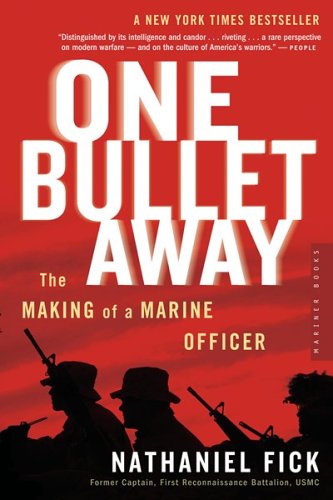
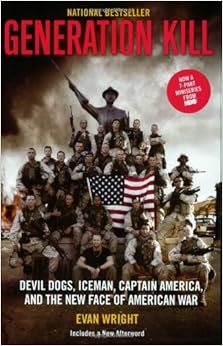
Nathaniel FickFor this comparison I used the book Generation Kill. The book is written by Rolling Stone Magazine reporter Evan Wright and provides an in depth first-hand account of the invasion of Iraq. Evan rode in the back seat of a hummer, part of the United States Marine Corps First Reconnaissance Battalion, Bravo Company. Yet, what proves most unique and beneficial in terms of comparing the text is the fact that not only was the book turned into an HBO mini-series, but a Marine who commanded the platoon of Humvees that Wright rode in also wrote a book. Nathaniel Fick’s One Bullet Away looks at his personal career in the Marine Corps, most of which is focused on his time in Iraq. As Fick is a lieutenant it means that he was almost always no more than two-hundred or so meters away from Wright, which in turns means the two texts are covering very similar and at most times identical events.

Evan WrightSo long story short, I took the text from Fick’s One Bullet Away, the text from Wright’s Generation Kill and the transcript from HBO’s Generation Kill and put them into individual word clouds. This is done in all honesty to satisfy my curiosity as I have read both books and watched the series several times. But in terms of research it can be said that I did this to compare a text written from the stance of the media/a non-combatant/someone with little knowledge in terms of military (asides from a brief assignment in Afghanistan), compared to a Marine lieutenant. I was also able to compare Generation Kill the book to the mini-series, which of course means that there would be a difference from a text consisting mostly of descriptions to a text consisting of primarily dialogue.


It is also important to keep in mind that while the series is highly accurate in accordance to the text it’s based on and most of the dialogue in the book has been translated to the series, there is still a large quantity of “made up” dialogue in the HBO series. However because of the creators great attention to detail and heavy communications with the marines who the series is based on dialogue that is made up still bares the mannerisms, similar opinions to an extent that it could have been said by the marines themselves. This helps to assure that commonly said words would have most likely been the words commonly used by the soldiers during the invasion.

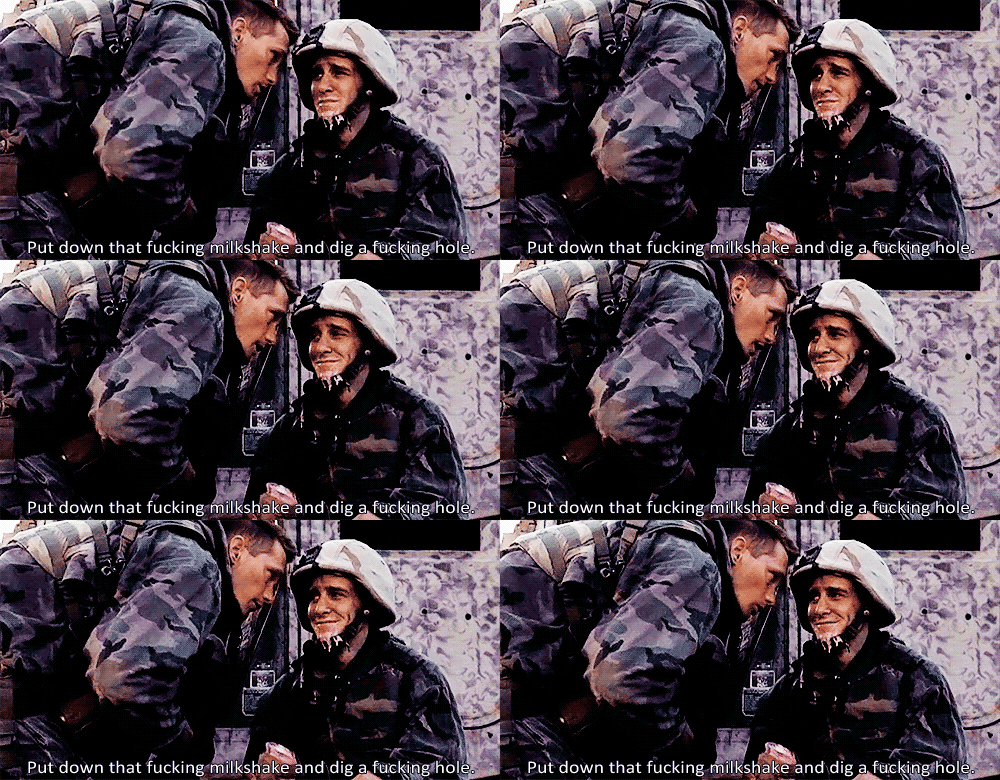
Scene from HBO's Generation Kill, episode two "The Cradle of Civilization"

Results of Wordle’s use to come in Part 2


Sunday, 25 January 2015

How things are going... for the project that is.

At this point in time my main idea/theme for my final project would be a form of internet exhibition based on the research I partook in this past summer at Murphys Point Provincial Park as the Gray Ratsnake Technician. I would use information gathered from this study as well as old data and information about the species and the park in order to create a more complete and "full" exhibit.

Of course there are a couple of issues that arise when attempting to cover such a topic. The first is the fact that this project for a digital humanities class. Need not fear, the fact that these snakes are an At Risk species means that they are already well on the radar of human beings, this in turn means human interaction, which in turn means the humanities ties in quite easily. Aspects ranging from "Why have we as human put the snake on the Species at Risk list?" to "what have we as humans done or not done to make this area such a hot spot for Gray Ratsnakes?" Along with that there is also the fact that being a part of nature, the snake and its environment fall under the Natural history side of things which is always entangled with cultural history. Then of course the history of research on the matter at hand can also be looked at, for example, "what was research like on this same species 20, 30, 40 years ago?" and how does that compare to the research I did this past summer. It goes on and on.

We knew snakes could
 swim, just didn't think
they would to the extent
that it would require
a boat...              
While the first issue, I must admit I solved rather quickly, the second issue stands in the sensitivity of the subject, and by that I'm not referring to the fact that snakes aren't the most popular creature in the world, but the fact that some parts of the data collected are not to be publicly revealed as per the Ministry of Natural Resources and Forestry. None the less, I have done presentations on the material so in the long run the majority of the information can be used, as long as info on specific locations are not revealed... so long story short, this blog mostly particular post consists of me jotting my ideas down in order to convince myself that this is what I want to do...

On that note, the site, if constructed in the manner I am thinking of right now, would have your main page featuring general information, and then each sub-page would act like different "wings" or "halls" of a museum, featuring on more specific parts of the subject.


Having worked at the park some difficulties I actually foresee (as opposed to the previous that I was just sorting out) is the fact that a lot of the information I have learned about the park have been through small pamphlets that, if I can recall correctly are short some sources. However, even then, there are small facts that would be subject to that issue, and even then some of it is still good, merely needing to come with a bit of a disclaimer...

And thats where I am, as it stands, I've gathered a fair bit of the information on the subject and so forth at this point in time, now its just a matter of getting it all sorted out and formatted.

Sunday, 18 January 2015

The Library of Congress Web Archives

The Library of Congress Web Archives covers information on around twenty-one more current (post 2000) events. Being the United State’s Library of Congress web archive, this means that there is a heavy focus on events in which the USA and its congress were heavily involved in, placing various limitations on what you can find (for as previously mentioned there are only 21 collections, and an additional visual images collection). The website has recently gone through a transformation in terms of formatting and can be found at this link: http://www.loc.gov/websites/ The upgrade’s most notable feature is the ability to better search for desired topics and significantly narrow down the search, this new styled website also makes the amount of information covered look more comprehensive that the previous site.

But what is the point of the Library of Congress Web Archives to start off with? Basically it has been put in place to capture web activity that corresponds with major US events. Browsing into certain events, such as the Invasion of Iraq in 2003 you can find websites covering a scope of information that related to “Operation Iraqi Freedom.” From political cartoons, websites for returning veterans and even site for pets with patriotic names. Pages for official military branches, anti-war website, news articles, and blogs are amongst the more frequently visited sites when it comes to this subject, but no matter what the source is this website does exactly what it is supposed to and what is desired by the likes of history students and professionals, especially those evaluating the digital humanities.


An in depth search brings me to the 2003 version of
the USMC website. This particular site is fully interactive.
By looking at this site we can gain valuable information on websites that are in some cases no longer existent, or that have been modified and modernized so much that they would not be recognizable.  What does this mean? Continuing with my example of the Iraq War, it means that we can gage public reaction on the internet; see how people felt about the conflict outside of the popular media, we as historians have been granted access to a massive collection of primary sources. We can also see how more official sources such as the United States Marine Corps and leading news agencies told the story of Iraq as they happened. And this case does not apply for only the Iraq war, information in readily available for other conflicts, elections and so forth. The Library of Congress Web Archives provides a large amount of preserved information on a specific scope of topics, which may also be its limitation as it does not cover as many sources as site like the Internet Archives. None the less even if you cannot find what you desire by using this source, which is bound to continue growing with time, it is definitely a good place to start when looking at more “current” US events.